The short answer
The Dr. Pen A20 offers nine fixed depth positions: a nano or 0 setting, then 0.25mm through to 2.0mm in 0.25mm increments. Shallower settings suit serum absorption and delicate skin and can be used often; deeper settings suit texture and scarring and need longer between sessions. Most home routines live between 0.25mm and 1.0mm, with 1.5mm and 2.0mm reserved for specific concerns and, at the top of the range, professional supervision.
Depth is the single decision that shapes everything else about a microneedling session — how it feels, how long your skin takes to settle, and how often you can repeat it. Speed, cartridge choice and technique all matter, but they matter around the depth you have chosen. The A20 makes that decision unusually easy to live with, because it does not ask you to guess.
We have been an authorised Dr. Pen stockist for seven years, and depth is far and away the thing customers write to us about most. This guide walks through all nine settings, what each one suits, how they map onto different areas of the face, and how to build a routine you can actually repeat over the months a course of microneedling takes.
Why nine fixed steps beat a continuous dial
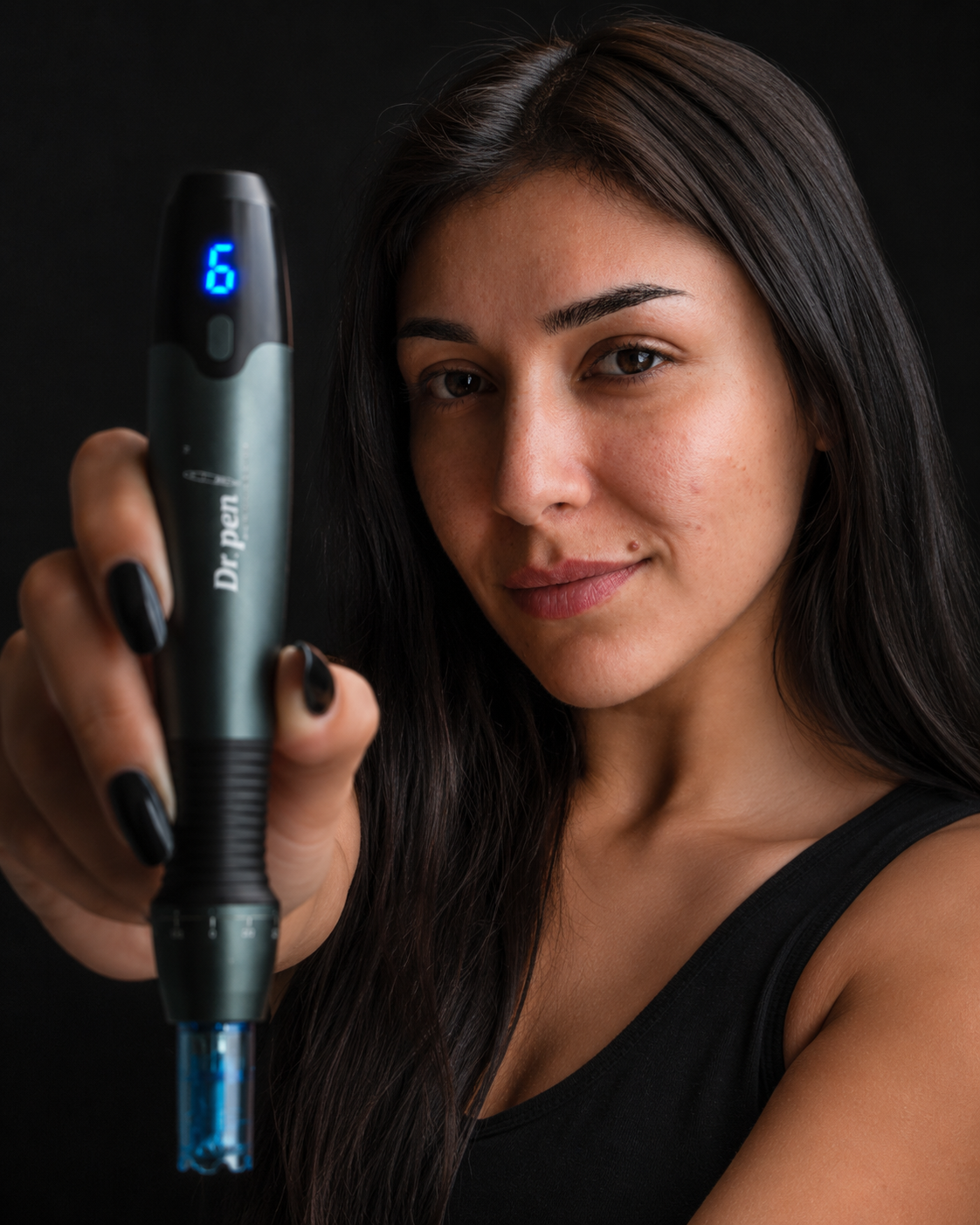
This is the part that matters most, and it is the reason we point people towards the A20 so often. On the A20 the depth adjustment moves through nine defined positions rather than sliding smoothly through every value in between. You are not aiming at a mark on a barrel and hoping you landed in the same place as last time — you click to a step, and the LED digital display tells you exactly which step you are on.
Microneedling is a course, not a single event. Results come from a series of sessions spaced weeks apart, and the only way to know whether a change helped is to keep everything else the same. If session three ran at "somewhere around 1mm" and session four ran at "somewhere around 1mm" as well, you have learnt nothing from the comparison. If session three ran at 1.0mm and session four ran at 1.25mm, you know precisely what changed and can judge the result.
Fixed steps also make it much harder to drift. On a continuous dial, a small knock during cleaning or a slightly firmer grip mid-session can move you deeper than you meant to go without you noticing. A stepped adjustment gives you a definite position that stays where you put it, and a display that confirms it before the needles ever touch your skin.
Worth knowing: the A20 has six speed levels running up to 7,700 RPM, and speed does not change depth. Speed affects how smoothly the pen glides and how comfortable the pass feels — the depth setting alone controls how far the needles travel. Raising the speed to "get more" out of a session does not make it deeper, and lowering it does not make a deep setting gentler. If you want a different depth, change the depth.
All nine A20 depth settings, and when each one suits
The table below is the reference most people want. Frequencies are a sensible starting framework rather than a fixed prescription — skin varies, and your own recovery time is the better guide.
| Setting | What it suits | How often |
|---|---|---|
| Nano / 0 | Used with a nano square cartridge, which has silicone tips rather than needles. Serum absorption, glow before an event, very sensitive or reactive skin, and anyone easing into the routine. | Can be used most days as skin allows |
| 0.25mm | Product penetration with a light stimulating effect. Overall radiance, mildly congested-looking skin, maintenance between deeper sessions. | Every second day |
| 0.5mm | The everyday working depth for many home users. Surface texture, enlarged-looking pores, dullness, early fine lines, uneven tone. | One to three times weekly |
| 0.75mm | A step up for skin that has comfortably handled 0.5mm. Texture and tone across the cheeks and forehead, pigmentation concerns, more established fine lines. | Roughly weekly to fortnightly |
| 1.0mm | Firmness and collagen-focused work on thicker facial areas. Shallow scarring, deeper textural change, more visible lines. | Every two weeks |
| 1.25mm | A measured intermediate step between 1.0mm and 1.5mm — useful when 1.0mm feels comfortable but 1.5mm feels like too big a jump. | Every two to three weeks |
| 1.5mm | Targeted work on established scarring and deeper lines, on thicker areas only, for experienced users. | Every three to four weeks |
| 1.75mm | Deep, spot-specific work on resilient tissue. Rarely needed across a whole face. | Every four to six weeks |
| 2.0mm | The A20's maximum. Reserved for significant scarring on thick-skinned areas and best approached with professional guidance. | Every six weeks, ideally under professional supervision |
Cartridge choice sits alongside depth: 12-pin heads concentrate the work for spot treatment and tight areas, while 14-pin heads are the usual all-rounder for full-face passes. Dr. Pen builds each cartridge to match a specific handpiece — A20 cartridges fit the A20, M8 cartridges fit the M8, and so on.
Depth by facial area
Skin thickness varies enormously across the face, which is why a single setting for the whole treatment rarely serves you well. The forehead and cheeks tolerate considerably more than the skin around the eyes. Adjusting as you move between zones is standard practice, not fussiness — and the A20's stepped display makes those mid-session changes quick and repeatable.
| Area | Typical range | Notes |
|---|---|---|
| Forehead | 0.5–1.0mm | Reasonably robust, but bone sits close to the surface. Keep the pen moving and let it do the work rather than pressing. |
| Cheeks | 0.5–1.5mm | The thickest facial area and where most textural and scarring work happens. The upper end suits experienced users treating established marks. |
| Nose | 0.25–0.5mm | Awkwardly contoured and thin over the bridge. A smaller pin count gives you more control around the sides. |
| Upper lip | 0.25–0.5mm | Sensitive and often the most tender zone. Vertical lines respond over time to patient, repeated shallow work. |
| Under-eye | Nano to 0.25mm | The thinnest skin on the face. Stay on the orbital bone, well away from the lash line, and many people prefer the nano cartridge here entirely. |
| Jaw and jawline | 0.5–1.0mm | Firmer tissue that tolerates a middle setting. Follow the bone line and ease off as you approach the neck, which is thinner than it looks. |
If you would like a second opinion on where a particular concern sits, send us a photo and we will confirm a sensible starting depth for you.
Depth by concern
Another way to approach the same decision is to start with what you are treating rather than where it sits.
- Serum absorption and glow: nano or 0.25mm. The goal is a temporary channel for your actives, not remodelling. Keep the serum simple and suitable for compromised skin.
- Surface texture and pore appearance: 0.5–0.75mm. Frequency does more here than depth — a steady weekly rhythm outperforms occasional deep sessions.
- Fine lines: 0.5–1.0mm on the face, dropping to 0.25mm or nano around the eyes and 0.25–0.5mm on the upper lip.
- Pigmentation and uneven tone: 0.5–0.75mm, applied consistently. Deeper is not better for pigmentation, and gentler settings are the sensible choice for deeper skin tones.
- Scarring: 1.0–1.5mm on the cheeks, worked as a course over months. Rolling and boxcar marks respond gradually; patience beats intensity every time.
Whatever the concern, active acne, broken skin, sunburn and any irritated area are best left to settle before you treat them. Our home microneedling guide covers preparation and aftercare in more detail, and the A20 how-to walks through a full session start to finish.
Why the A20 stops at 2.0mm — and when another model suits better
The A20's range tops out at 2.0mm, and that ceiling is deliberate. For facial work, 2.0mm is already the deep end: settings beyond it belong to body treatment on much thicker tissue, and the A20 is built and cleared as a face-focused device. It carries FDA 510(k) clearance, which means the device has been cleared for marketing on the basis of substantial equivalence — clearance, not approval, and the distinction is worth knowing when you compare claims across brands.
Where the ceiling can matter is body work. Stretch marks on the abdomen, thighs or upper arms, and scarring on the back or shoulders, often call for 2.5mm, which the A20 simply does not offer. If body treatment is a real part of your plan, the Dr. Pen M8 reaches further and is the more sensible buy. Our models compared guide sets the range side by side, and if the A20 is the one you are weighing up, the full A20 review and is it worth it piece go deeper still.
For faces, the 2.0mm limit costs you nothing. Very few home users have any reason to go past 1.5mm, and the A20's finer 0.25mm steps through the range you actually use are worth more day to day than a headline number you will never select.
Building up over sessions
Choosing your eventual working depth is less useful than choosing where to begin. Skin adapts, and comfort at a given setting tells you a great deal about whether to move on.
- Begin one full step below where you expect to end up — 0.25mm or 0.5mm is a reasonable first session for most people.
- Hold that depth for two or three sessions and note how quickly redness settles. Same-day or next-morning recovery suggests you have room to progress.
- Move up one 0.25mm step at a time, changing nothing else in the session so you can attribute the difference.
- Let deeper settings have longer between them. Depth and frequency trade against each other — as one rises, the other falls.
- Step back down whenever skin feels reactive. Returning to 0.5mm for a few weeks is progress, not a setback.
The A20's AVOS vertical oscillation matters here too. The needles travel straight in and straight out rather than dragging at an angle, which is what makes the depth setting mean something consistent from pass to pass. Keeping your hand light and letting the motor set the rhythm is more important than covering ground quickly.
Recording your settings so you can repeat them
A short note after each session turns nine fixed steps into a genuinely repeatable routine. Write down the date, the depth for each zone, the cartridge and pin count, the speed level, the serum used and how your skin looked the following morning. Three or four lines is plenty.
Two months later, when you are deciding whether to move the cheeks from 1.0mm to 1.25mm, that log answers the question for you. Without it you are relying on memory across a gap of weeks, which is exactly where routines quietly drift. The A20 gives you a display that reports the setting precisely; your notes are what make that precision useful over the length of a course.
Practical housekeeping helps too: fit a fresh cartridge for every session, use the protective sleeves supplied in the kit, sterilise the handpiece surface between uses, and keep the pen charged on its dock so a low battery never shortens a session. The three-lock cartridge connection with its anti-backflow interface is there to keep serum out of the handpiece, so seat each cartridge fully. If anything about the pen behaves unexpectedly, our troubleshooting guide covers the usual causes.
Frequently asked questions
Does a higher speed setting make the needles go deeper?
No. The A20's six speed levels change how quickly the needles cycle, which affects glide and comfort, not how far they travel. Depth is set by the depth control alone. Many people find a middle speed the most comfortable for facial work.
What depth should I start with on the A20?
0.25mm or 0.5mm suits most people for a first session. It gives you a real sense of how your skin responds without a long recovery, and you can step up by 0.25mm at a time once you know. Our needle length guide goes through this in more detail.
Can I use different depths in one session?
Yes, and most people do. Changing depth as you move between the cheeks, forehead and under-eye area is normal practice. The stepped adjustment and digital display make the change quick, and you will know exactly what you used in each zone.
How deep can I go around the eyes?
The under-eye area is the thinnest skin on the face, so nano or 0.25mm is the usual choice, worked over the orbital bone and well away from the lash line. Plenty of people use a nano square cartridge here and nothing deeper.
Why doesn't the A20 go to 2.5mm?
The A20 is designed around facial treatment, where 2.0mm is already the deep end of the range. Settings beyond that are for thicker body tissue. If stretch marks or body scarring are part of your plan, the M8 reaches further and is the better fit.
How often can I microneedle at 1.0mm?
Roughly every two weeks is a sensible rhythm at 1.0mm, though your own recovery is the better guide. Shallower settings can be repeated far more often — 0.25mm every second day, 0.5mm one to three times weekly.
Do A20 cartridges fit other Dr. Pen models?
Dr. Pen builds each cartridge to match a specific handpiece — A20 cartridges fit the A20, M8 cartridges fit the M8, and so on. Buying the cartridge that matches your pen keeps the connection secure and the depth accurate. Current pricing is on the product page.
I am not sure which depth suits my concern. Can you help?
Please do ask. Send us a photo and a short description of what you would like to work on, and we will confirm a sensible starting depth and cartridge for you. After seven years as an authorised stockist we have seen most situations, and we would rather help you start in the right place.
If you are ready to begin, the Dr. Pen A20 arrives with the handpiece, charging dock, two 14-pin cartridges, cable and adapter, ten protective sleeves and a guide. Cartridges are available separately in 12, 14, 18, 24, 36 and 42 pin as well as nano square. Current pricing is on the product page.
Please speak with your doctor before purchasing any Dr. Pen product. This content is not intended to substitute for the advice of a qualified physician, pharmacist or other licensed healthcare professional.